DESCRIPTION
This patented technology introduces a biodegradable, passive soil sensor designed to improve soil condition monitoring while minimizing environmental impact. The sensor consists of a biodegradable substrate embedded with electrically conductive, bioinert metallic traces (e.g., aluminum or magnesium), which form a printed circuit, antenna, and optional sensor components. It includes an encapsulation layer made from biodegradable polymers such as polylactic-co-glycolic acid (PLGA), protecting the electronics during deployment and ensuring safe degradation in the soil over time.
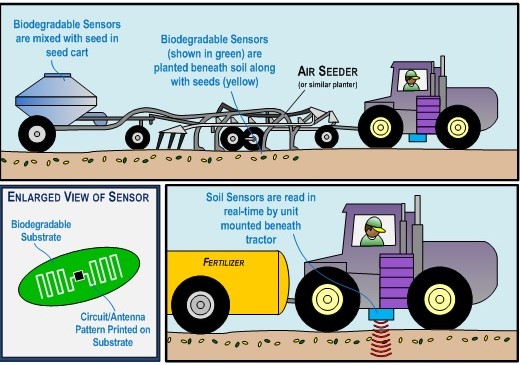
The sensor functions wirelessly using passive RFID technology, eliminating the need for an onboard battery. It can be deployed at planting time using standard seeding equipment and communicates with remote readers (mounted on tractors, drones, or planes) to transmit soil parameters like moisture, temperature, pH, ion concentration, and conductivity. These parameters are measured in-situ, providing high-resolution, real-time data directly from the soil.
Advanced fabrication techniques, such as micro cold spray (MCS) and direct-write printing, enable the deposition of high-conductivity metallic traces onto biocomposite substrates. The system is designed for cost-effective mass deployment, with sensors small enough to mimic the size and form of common crop seeds. After a defined operational lifespan, the entire sensor degrades harmlessly into the soil, avoiding retrieval and reducing waste.
Picture demo of biosensor uses in seed planter
 |
Benefits
Applications
-
Precision agriculture and farm management
-
Soil health and nutrient monitoring
-
Environmental impact assessment
-
Smart irrigation systems
-
Research in soil science and agronomy
-
Remote sensing integration for crop optimization