DESCRIPTION
Additive manufacturing (AM) has made significant advancements since Charles Hull introduced stereolithography in 1987. Today, it encompasses a wide range of materials, including polymers, ceramics, and metals. However, one persistent challenge has been achieving Z-directional reinforcement in 3D-printed composites. This difficulty arises from issues with resin flow and inadequate fiber integration. Enter an innovative 3D printing nozzle design that promises to overcome these hurdles. By utilizing the venturi principle, this nozzle creates a low-pressure zone that facilitates the introduction of continuous fiber reinforcement into the reactive resin during the printing process. This seamless integration of fibers into the resin flow ensures optimal wet out and resin infusion, which are essential for producing high-strength, mechanically superior parts. This breakthrough not only enhances the strength of composite parts but also significantly improves fiber wet out, making it a game-changer in the field of additive manufacturing.
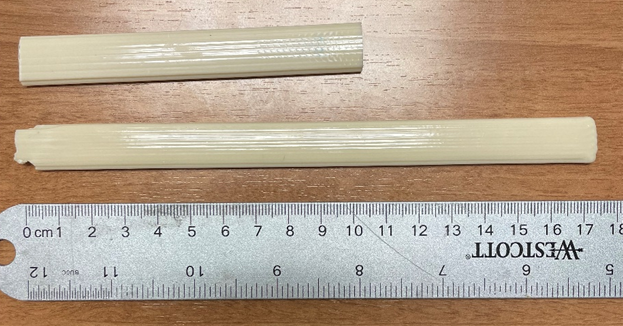
Cream Resin Test Specimens
|
|
Benefits
-
Improved resin infusion and wet out of continuous fiber reinforcement, minimizing imperfections and weak interfaces.
-
Enhanced Z-directional fiber reinforcement for stronger, more robust composite structures.
-
Suitable for use in industrial and benchtop 3D printers.
-
Reduced post-processing requirements due to efficient in-situ curing.
Applications
-
Aerospace and automotive components demand lightweight and strong materials.
-
High-performance sporting goods.
-
Customized industrial machinery parts.
-
Advanced construction materials.
Patent
This technology has a Patent pending and is available for licensing/partnering opportunities.